
History · Public Notes
How the Protests Started After Lahore — and Who Led Them
After the Lahore resolution and the 26 January 1930 pledge, the question was: what does a pledge do? Gandhi's answer was to pick a law everyone felt, and break it peacefully, in public.
How it started — salt, not a slogan
Gandhi chose the salt tax because salt was used by rich and poor alike, and Britain held a monopoly on making it. He wrote to Viceroy Irwin in advance that he would break the salt law, then:
- 12 March 1930: Gandhi left Sabarmati Ashram, Ahmedabad, with 78 selected volunteers, on the Dandi March
- 5 April 1930: after walking about 390 km, they reached Dandi
- 6 April 1930: Gandhi broke the salt law by making salt from seawater — that act formally launched the Civil Disobedience Movement
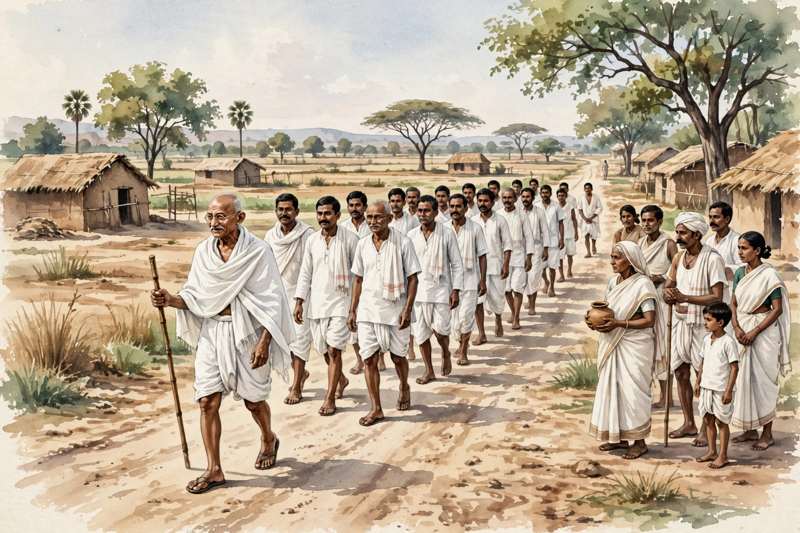
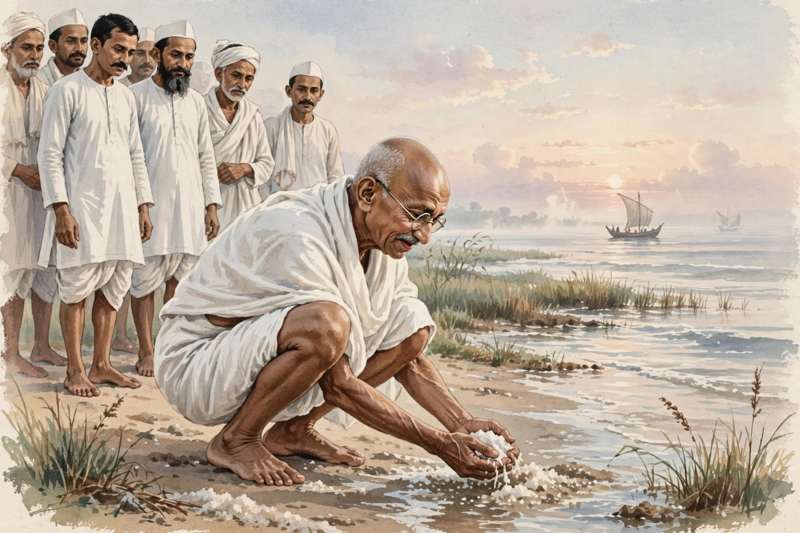
From there it spread wherever the sea was within reach, and then beyond salt: no-tax campaigns, boycotts of foreign cloth, and picketing of liquor shops.
Who led it — not one man, but a chain of leaders
- Mahatma Gandhi — the starter: led the Dandi March, broke the salt law at Dandi, was arrested on 5 May 1930 at Karadi, near Dandi
- Jawaharlal Nehru — United Provinces: arrested early, in April 1930 in Allahabad, and led the no-revenue / no-rent campaign there
- Sardar Vallabhbhai Patel — Gujarat: organised ground support and logistics for the march, and led the no-tax / land-revenue campaigns in Bardoli and Kheda
- C. Rajagopalachari — Tamil Nadu: led the salt satyagraha march to Vedaranyam
- Khan Abdul Ghaffar Khan — North-West Frontier: mobilised the Khudai Khidmatgars, the “Frontier Gandhi” movement, in non-violent protest at Peshawar
- Sarojini Naidu, Kasturba Gandhi, and thousands of women — Dharasana and beyond: after Gandhi's arrest, the Dharasana Salt Works raid fell to Sarojini Naidu, Imam Sahib, Manilal and others. On 21 May 1930, volunteers walked forward unarmed, were beaten with steel-tipped lathis, and did not raise a hand to resist — an event reported worldwide by American journalist Webb Miller
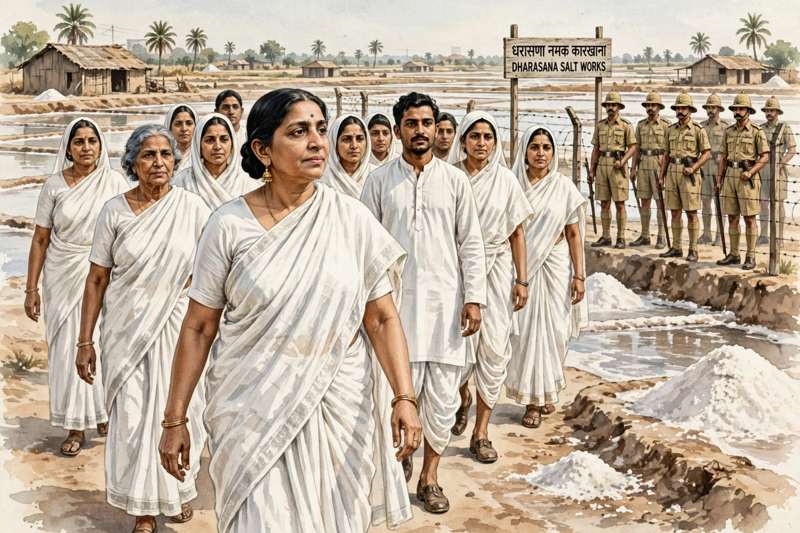
That chain is the point: when one leader was arrested, the next took the same walk. The protest did not stop at Dandi — it started there.
Why salt worked as a protest
It was small enough to do by hand, clear enough to understand, and impossible to dismiss as abstract. A handful of salt, made in public, said: we will not obey an unjust law, and we will not use violence to disobey it.
Verification note: these are AI illustrations, not 1930 photographs. The people are generic likenesses, not verified portraits, and the scenes are recreations. The dates, places, leaders, and sequence are checked against the history above.